Tutorial Memanah

Memanah olahraga tradisional yang akan terus ada hingga akhir zaman.

Tampilkan postingan dengan label Artikel panahan. Tampilkan semua postingan

Selasa, September 10, 2019

Teknik Dasar Memanah untuk Pemula Banget (Recurve/Standard Bow)


Jaman sekarang gak susah cari pengetahuan tentang apapun, termasuk tentang panahan. Bisa dari google, blog, buku, youtube, forum, dll. Tapi seperti yang saya bilang diatas, pelatih/coach adalah yang utama dibutuhkan seorang pemanah pemula. Jadi lebih bagusnya langsung datangin klub2 panahan aja yang ada coachnya, kayaknya sekarang udah tersebar dimana2. Artikel ini supaya dijadikan gambaran kasar aja. Saya juga cuma mau bahas sekedarnya, kan judulnya juga buat pemula banget.

Dimana2 kalo dasar panahan pasti yang diajarkan langkah2 dibawah ini, paling beda dikit2 aja dari penamaan atau variasinya.

Stop! sebelum lanjut, ini yang pertama harus kamu tau: Jangan melakukan yang namanya dry fire! (menarik string terus dilepas tanpa anak panah). Dry fire banyak dilakukan orang pas pertama kali pegang bow/busur, gatel aja kayaknya kalo gak narik.

1. Stance (sikap berdiri)

Ada beberapa jenis stance, tapi untuk pemula yang disarankan adalah square stance. Kenapa? Olah raga panahan paling butuh yang namanya konsistensi. Square stance ini paling mudah untuk diulangi terus menerus dengan sama/konsisten. Tinggal ambil garis lurus aja sama target.

Square stance, ujung kaki lurus sama tengahnya target.
Kakinya dibuka selebar bahu. Badan tegak yah.


2. Nocking the Arrow (pasang anak panah)

Masangin nock ke nocking point sampe bunyi klik. Yang harus diperhatikan disini adalah fit atau nggaknya itu nock ke string. Kalo terlalu kenceng ngaruhnya ke akurasi, tapi gak begitu masalah kalo buat pemula yang masih mempelajari teknik, belum penting kalo masalah akurasi. Yang bahaya itu kalo terlalu longgar. Bayangin kalo ditengah proses narik string terus si nocknya melorot atau lepas dari string dan kelepasan ngerelease. Bisa lari ke jidat orang itu arrow/anak panah.

Juga perhatiin posisi fletching (vanes atau bulu unggas), biasanya yang warnanya beda sendiri itu ditaro diluar/menjauhi riser/handle.

Posisi naro arrow/anak panah di arrow rest juga diperhatiin, jangan sampe jatoh dari arrow restnya. Karena bahan arrow rest biasanya sangat fleksibel untuk standard bow.

Cara pasang nock ke nocking point, posisi yang beda warna sendiri menjauhi riser, dan cara naro arrow di arrow rest.


3. Set

Langkah selanjutnya adalah cara pegang bow/busur plus megang stringnya.

Megang bow/busur harus rileks ya, kalo tegang bisa muncul masalah yang namanya "bow torque". Yang kurang lebih artinya kita ngasih torsi ke samping pada bow/busur. Jadinya nanti arrow/anak panah larinya bakal melenceng ke samping.

Detail cara pegang bow/busur dan string dijelasin sama gambar2 dibawah ini.


Cara pegang bownya, gambarnya udah jelas banget kali ya.
Gambar barisan paling atas yang ada arsiran lonjong artinya tekanan busur dipusatkan disitu.
Gambar yang barisan tengah adalah beberapa variasi yang berbeda, tanda ceklis itu yang bener. Bebas pilih diantara tiga yang diceklis dirasain mana yang paling rileks.
Gambar barisan paling bawah itu nunjukin megang bow/busurnya jangan terlalu dalem juga jangan terlalu luar dari telapak tangan.

Pemula biasanya megang bow/busurnya kenceng banget. Merasa takut lepas. Lama2 ketika mulai terbiasa baru bakal lebih rileks.

Lanjut ke cara megang string. Harus pake finger tab ya, biar gak terlalu sakit tangannya. Di gambar ini finger tab gak diliatin biar jelas posisi jarinya.


Cara pegang stringnya, sangkutin string di ruas jari pertama.


Jangan terlalu dikit nyangkutnya, takut release gak sengaja.
Jangan juga terlalu dalem ntar susah releasenya.
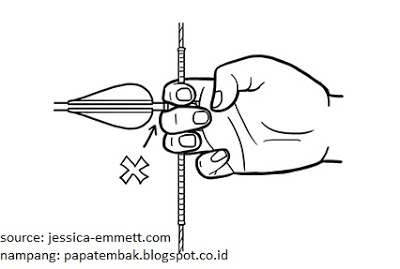
Kayak gini yang namanya teknik split finger, telunjuk diatas, jari tengah sama jari manis dibawah. Nock ada diantara telunjuk dan jari tengah.


Nocknya gak boleh dijepit yah. Ntar suka jadi goyang2 arrow/anak panahnya, terus ngangkat bahkan sampe bikin jatoh dari arrow rest.

Kayak gini kalo diliat dari belakang.

Sampe tahap ini bow/busur masih ngadep bawah kayak gambar di bawah ini:


4. Set-up

Langkah selanjutnya adalah menoleh ke arah target, menarik string dikit lalu mengangkat tangan yang pegang bow/busur. String ditarik dikit supaya posisi tangan yang megang bow lebih stabil dan gak berubah lagi posisi sikunya.

Posisi set up.

Yang harus diperhatikan adalah posisi siku yang harus agak diputer jadi lurus kayak gambar di bawah ini. Catatan: ini adalah pemanah kidal. Dan posisi string harusnya belum ditarik sejauh ini kalo posisi set up.


Gambar yang atas itu contoh yang salah, namanya juga bintang pelm bukan archer beneran. Kalo posisi siku kayak gitu dijamin bakal kena jepret string. Sampe ungu bro.
Gambar yang bawah baru bener, itu modelnya atlit olimpiade. Sikunya dibikin lurus jadi string bisa lewat dengan mulus. Kalo tangan keserempet selain sakit juga arrow/anak panah bakal melenceng dari target.

5. Draw (tarik)

Tarik string sampe nyentuh idung sambil mempertahankan posisi tangan yang megang bow/busur tetep lurus, Kepala juga tetep diem yah, string yang deketin idung. bukan idung yang nyamperin string.


Posisi Drawing

bahu kiri dan kanan tetep sejajar. Biasanya kalo belum terbiasa bahu yang nahan bow/busur suka naek karena nahan berat.


Posisi salah, bahu yang megang bow/busur naik. (Ini foto archer kidal)

6. Anchor (jangkar)

Pada saat full draw itu kan beban ada di titik paling berat tapi kita masih harus nahan beberapa detik buat proses selanjutnya. Nah si tangan biar gak goyang2 ditempelin di anchor point.

Anchor juga banyak macemnya, yang paling umum sih yang ditaro di bawah dagu kalo buat recurve/standard bow. Supaya anchor point ini bisa diulang terus menerus dengan konsisten, kamu harus punya beberapa titik referensi. Misal string nempel di ujung hidung, string nempel di pinggir dagu, dll. Pokoknya dirasain dan diinget2 apa yang kerasa. Jadi kalo pas kebetulan posisinya agak melenceng dari yang biasanya kamu bisa ngerasain bahwa itu salah.


Posisi Anchor.


7. Transfer

Maksudnya transfer disini adalah mindahin otot yang narik string dari otot lengan ke otot punggung. Otot punggung lebih besar dan lebih kuat. Jadi pergerakan string akan lebih stabil.

Setelah anchor, string terus ditarik (tidak berhenti) tapi dalam kecepatan yang sangat sangat pelan. Kalo sampe berenti dulu pas anchor biasanya susah pas mulai narik lagi.

8. Aim (bidik)

Membidik sering membuat pemanah jadi tidak memperhatikan teknik yang lain. Karena terlalu fokus membidik jadi lupa teknik memposisikan siku, tangan, pinggang, bahu, dll. Padahal kalopun si fisir pas ditengah kalo teknik kacau arrow/anak panah juga larinya bakal ngaco. Apalagi kalo membidiknya sampe terlalu lama, otot yang nahan string pasti bakal capek, otomatis nanti releasenya juga gak akan bener. Akurasi udah pasti awut2an.

Coba perhatiin atlit2 lagi memanah. Proses dari mulai draw/narik sampe release rata2 dibawah 5 detik. Itu atlit loh yang ototnya udah dilatih gila2an tiap hari.


Gambar kiri membidik dengan sight/fisir. Pas full draw kamu bakal bisa liat string tapi blur/gak jelas. Si string ini paling umum ditempatkan di sebelahnya aperture (bagian dari fisir yang bentuknya kotak ada titik di tengahnya) kayak di gambar. Penempatan string ini dinamakan line up, ada juga yang bilang string picture, string blur, dll.

Gambar kanan membidik tanpa fisir, yaitu dengan acuan ujung arrow/anak panah. String, shaft, dan ujung arrow ditempatkan di garis yang sama.

9. Release (lepas string)

Otot punggung tetep terus menarik string, gak berenti, tapi dalam kecepatan yang sangat lambat. Lalu lemaskan otot jari yang megang string.

Kalo drawing/narik string berenti, namanya dead release/plucking. Intinya bakal berpengaruh ke akurasi.


Posisi release.


10. Follow-Through (gerak lanjutan)

Menurut saya pribadi, follow through adalah indikasi dari proses sebelumnya. Bukan apa yang harus dilakukan dengan paksa. Kalo langkah2 diatas dilakukan dengan benar maka follow throughnya pasti bagus dan terlihat natural. Cirinya follow through yang bagus itu tangan kanan gak jauh2 dari leher. Tapi bukan juga dead release atau plucking.

Tangan yang megang bow/busur jangan dulu diturunin/berubah posisinya sampe arrow nancep di bantalan.

Posisi follow through. Perhatikan posisi tangan kanan yang gak jauh dari leher.
Kalo pake stabilizer dan megang bow/busur dengan teknik open hand, si bow bakal jatoh mengayun ke depan karena bagian depan bow/busur yang berat.


Saking pentingnya saya harus ulangi sekali lagi: Coach/pelatih gak bisa digantikan dengan baca atau liat youtube. Kalo kamu belajar sendiri tanpa ada yang ngawasin, lalu ngelakuin sesuatu dengan salah terus terusan. Lama2 kesalahan itu jadi kebiasaan buruk yang bakal susah ilang. Bukannya tambah jago malah tambah ngaco.

Rabu, Februari 12, 2014

History and Making of the Bow


I. Early Bows

II. Ancient Middle East

III. Europe in the Middle Ages

IV. Early American History

V. Olympic Archery

I. Early Bows

You can always find a mention of archery in literature, art, Greek mythology, language, warfare, Humanities, and much more. The bow was such a pivotal device back in the past, that many historians consider it almost as important as the wheel and fire.

Simply stated, the bow is a stringed projectile weapon designed to shoot arrows. It consists of a slender stave (the bow-stick) and a cord fastened to it at each end under a certain amount of tension. By drawing the string and the arrow back until the stave is bent, and then releasing the string, the impelling force of the bowstring shoots the arrow5. Though it sounds easy, many bows require as much as hundreds of pounds of force to bend the bow sufficiently and then incredible marksmanship to make the arrow fly true.

Bows are of two basic kinds: wooden and composite. The earliest bows were undoubtedly made from wood, probably simply cut from saplings and whittled into the desired shape and strung with animal gut. These earliest of bows developed into the short bow, longbow, and various other plain bows.

Composite bows were made of either part wood and other material, or entirely out of other materials. In areas where wood of suitable kind and sufficient quantities were not to be had, composite bows developed. Horn, bone, sinew and gut in various combinations were used in place or in conjunction with wood. Usually the
stave would be of a wooden core, with the back side (side facing the target) covered with animal sinews or tendons, and on the belly (side facing archer) would be applied horn, or sometimes metal.

The reasons for the uses of horn and sinew in bow making become apparent when you look at their properties. The horn was placed on the belly of the bow because horn resists compression, and springs back into shape the moment pressure is released. Sinew is, on the other hand, elastic and was placed on the back of the bow because after it is stretched it quickly shortens back to its original shape. When the two materials were applied this way, the composite bow became much more powerful than its predecessor could ever be.

The Chinese composite bow differed from the usual composite in that it was made entirely out of vegetation. The back would be made from a strip of fresh bamboo that was cut after the end of the growing season (in place of elastic sinew) and the belly would be made from dried, year-old bamboo (in place of the compression-resistant horn). Vegetable glue was applied and the whole thing was lacquered.

To attach the bowstring, a nock (notch) was made at both tips of the bow where the ends of the bowstring could be inserted. Usually a nock was made on the back of a bow, but sometimes on the sides as well. For some bows, such as ones that tapered at the tips and grew in thickness towards the grip, no nock was made since it was not necessary. A loop at the end of the bowstring could be slipped over the tip where it would remain unaided.

To string a bow, one end of the bowstring is slipped over one of the tips and down the bow until the other end can be secured to the nock of the bow. Then the secured end is braced, usually with a foot, while the first end of the bowstring is brought toward the tip until it can be secured in its nock. Whenever a bow was not in use, it would usually be unstrung.
Well into the end of the Ice Age, when the ice had retreated to approximately its positions today, the use of wooden and composite bows was spreading all over the world. Wooden bows were used in Western Europe, Iceland, most of Africa, India, the island groups of the Indian and Pacific oceans, and the greater parts of North and South America. Composite bows were used in some parts of Eastern Europe and North America, isolated parts of South America, and exclusively through what is now Russia and China, the northern half of North America, and the coastal parts of Greenland1.
The first stone arrowheads were discovered in Africa before 25000 BC, which indicates that the bow and arrow most likely developed there as early as 40000 BC. The spear would have come before the bow, and both instruments used side by side. Fire-hardened arrow points, flint tipped arrows, and feathered arrow shafts
probably appeared anywhere from 25000 to 18000 BC. Top


II. Ancient Middle East In the Egyptian Era they used stronger wood and horn glued together thus creating a more powerful and durable bow. It is estimated that the draw weight for bows shorter than a man’s height was 150-200 pounds. These ancient hunters are believed to have used arrows that were two to two and a half feet long with a bronze arrowhead. Also, in the Nile region came the first extant bow, which is believed to be between 3,500 to 4,000 years old. This bow shows that the Egyptians had mastered the design and construction of the long bow.

Also during this era, the Israelites made bows out of reed, wood, and water buffalo horns. To get rid of the horn’s brittle surface, they soaked the horn in water and then scraped off the brittle outer-layer. The sinew backing came from the select Achilles tendon of cattle. As for the bonding material, the end pieces of tendon
were cooked until pliable. Then water was added to the mixture, making it into a broth that was stored in small bins for later use. After some time, the broth jelled and was then diluted and cooked again. The bonding material formed from the broth has yet to be surpassed even today.

Bows were found in Denmark dating back to approximately 9000 - 6000 BC. These were one piece bows of yew and elm and tillered, meaning they had an equal amount of bend on the top and bottom. The first composite bow appeared in about 2800 BC. It was most likely developed in Asia, though it was also widely used in Egypt.


The Parthians (of now Iran/Afghanistan) became excellent horsemen and archers. They used a tactic of shooting with their upper half of the body facing towards the enemy and firing backwards while going at full gallop, which became known as "a Parthian shot." The Parthians tried to invade Rome in 53 BC, but their
archers proved no match against the garrison walls. Likewise, the Romans tried to invade Parthia in 37 BC, but they lost thousands to the Parthian’s hit and run techniques.

About 500 AD the Byzantines used mounted archers in their cavalry charges against the Saracens, Vandals, Goths and Franks, although through to 900 AD they also used archers on foot.

The Mongols were excellent mounted archers. About 1208 AD, they used high stirrups which allowed them to shoot in every direction. They also used composite bows with draw weights of 70-160 lb. and used thumb rings to release their bowstrings which allowed them to considerably increase their range. Top


III. Europe in the Middle Ages During the Crusades, about 1099 AD to 1192 AD, the English knights and crossbow men attacked the Mohammadean army who used mainly mounted archers with composite bows.

The unarmored soldiers wore loose silk undershirts that would not tear with
the impact of an arrow. The whole arrow could then be removed by carefully
pulling on the shirt. This minimized serious cuts and infections.

Since bows were made from organic materials, they decayed and disappeared
over time long ago. What we have to date them with, therefore, are the arrowheads of flint, stone and obsidian, and pictures carved into stone or painted in caves.

Through the course of time, the wooden bow was made longer as fit the needs of archers on foot. At first, bows were small and simple. For example, the Normans employed a bow only 1 1\2 meters long but it proved a formidable weapon as the Norman army, led by William the Conqueror defeated the British forces at Hastings in 1066. Learning well the lesson, the British improved their ordinary bow until it became the renowned longbow which would be as tall, or taller than the archer himself. There were considerable advantages to the longbow,
such as, its great range of fire and the fact that one could shoot a large number of arrows at a time. A good line of long bowmen would be quite impenetrable and opposing troops would not last long.
In areas where a bow was needed, it could be shot equally well from horseback or chariot, the composite (sometimes called recurve) bow was developed. However sometimes the two types of bows would be used within the same culture and time. In which case the ordinary folk and soldiers used the simple or self bow, while the composite was reserved for the loftier positions of high society.

The legendary William Tell was said to be a traveling story teller. In 1307 AD he was ordered to shoot an apple off his son’s head because he refused to bow to a hat put on a pole as a sign of imperial authority. He succeeded in shooting the apple, but some tellings of the story say that he had an extra bolt hidden on him. This was in case he accidentally killed his son. If so, he would shoot the official who had ordered him to shoot the apple.

At the battle of Crecy, August 26 1346, Edward III of England led his army against the French. It had rained the day before, and some reports say the English archers kept their flax bowstrings dry under their helmets. As the French force attacked, their bows misfired or their strings snapped, probably due to the weather. The English showered them with arrows. Many French crossbow men fled and their cavalry charged. But, they were no match for the English longbow men. 1,542 Frenchmen were killed, while, only 50 Englishmen fell.

As the 15th century rolled by, use of the bow in England began to dwindle. In 1472, the practice of archery went down because of a shortage of bow staves. In 1477, Edward IV of England banned an early form of cricket because it was interfering with regular archery practice. Crossbows were banned in 1508 to promote and increase the use of the longbow. With the invention of the musket in 1520, the fate of the bow in Britain was just about sealed. In 1588, the English fleet used the musket to defeat the Spanish armada, and in 1595 all bows were ordered to be replaced by muskets. The last battle in which English archers were used was the battle at Tipper Muir in 1644.

Since the danger of material shortages for bows was ever present, a cultivated supply was needed. The emperor Chalemagne (768-814), in addition to many military changes, ordered that the bow be made a regular weapon for certain divisions of his troops and, also, that the yew tree be cultivated to ensure a plentiful supply of its wood that was excellent for bow staves. Many centuries later, Charles VII , another king of France ordered that yew trees were to be grown in every Normandy churchyard. The British, large consumers of yew, made a trade agreement with Italy (for Italian yew wood was known to be of superior quality) that with every import of wine a trunk of yew would accompany it.

Archery groups were very popular at that time. Henry VIII started a number of archery groups for sport. The first group was called a "Patent of King Henry VIII Concerning Archerie (Old English Spelling)". In Patent, it states that any member of the group can not be prosecuted for accidentally killing a pedestrian. Another famous archery group was "The Society of Finsbury Archery", which was organized in 1652. It held the first organized archery contest in 1583 with over 3,000 participants. Sir Ashton Lever founded the final famous archery group
of that time period in 1781, called the Royal Toxophilite Society, which is still in existence today.

Even though the bow and arrow is an ancient weapon, archers have maintained military significance in many countries until recent times. Kalmuck mounted archers, irregulars in the Russian army, succeeded in troubling Napoleonic troops several times. Even in the Second World War, a detachment of American archers were used in several specialized actions in Asia. Yet even as the use of the bow has declined militarily, it is still pursued as a sport in many countries worldwide.

However, in the so-called underdeveloped parts of the world the bow may still be found in use. The Pygmies of Africa use a very short, simple bow with a rounded stave. Among the indigenous people of the Amazon it is used as well. The people of the Andes use bows shaped like a rectangular cross-section, and in the Congo and New Guinea a semi-circular bow is used.

Interest in bow hunting had just begun anew right before World War II. After the war, those veterans that had been archers took up their bows again, yet soon they were joined by more and more enthusiasts. As interest climbed, various state agencies started setting up special hunting seasons for the growing number of bow
hunters. Top


IV. Early American History


The archers of the Americas were masters of the bow long before European cultures began to spread across the continents. In the open plains strong bows of great range were used and in the woodlands where stealth and cunning was needed, lighter bows were used. The final early bow was that of the Eskimos of the Western

Hemisphere. The bow of the Eskimos, which was constructed out of spruce tree and sinew, was used for hunting, as well as, warfare. The arrows that they used were either one of two things, driftwood or splintered mammoth bones, held together with feathers from a ptarmigan. The arrows were then tipped with needle like bones. The Native Americans became proficient in both the wooden bow and the composite. The bow became such an important tool that it was regarded as a symbol of magic, power, or prowess.


Archery as a sport wasn’t really around in the United States until a group of Philadelphia gentlemen founded the United Bowmen in 1828, a club still in existence today. As the sport became more widely accepted, the National Archery Association was founded in 1879. Any further growth in archery was held back in the 1930s by the Depression. Yet, the sport was preserved by Howard Hill, an excellent bowman, who made short movies about bowhunting and trick shooting. Later, as the devastating effects of the Depression subsided, sportsmen began to take up archery once again.


Scientists began to take interest in the physics behind archery and established a criteria for the efficiency of bows and arrows. Later, scientist/ bowmakers began to experiment with a new material, fiberglass, in the design and manufacturing of bows.


Archery tournaments as we know them can be traced to England, where such events were part of grand community festivals since the seventeenth century. Target archery is perhaps one of the earliest forms of competition archery, which, besides England, is practiced in many other countries. The target archery field is level and clear, with targets of varying distance. Field archery is just like it sounds. A very irregular shooting ground which provides practical training for field hunters. It is an American sport and, since, very few other countries practice field archery, there is no international tournament. Top


V. Olympic Archery


The type of archery done at the Olympics is target archery which is supervised and regulated by the National Archery Association. Archery was made part of the Olympics in 1900, in Paris, France, and continued in 1904, 1908, and 1920. 1904 and 1908 being years when women competed. The bow of choice back then was the longbow because it was the easiest to use back then. Unfortunately, popularity was one of the weaker sides of Olympic archery. It was hard to even get a stand full of people to see people shoot in the early years of Olympic archery. Furthermore, each country’s team used different rules and formats. It became too chaotic to continue.
It was finally reinstated in 1972 for men and women. 1984 was a key year for Olympic archery because, during the Los Angeles games, the stands were completely packed with spectators watching the game. Because of this new found interest in archery, advances have been made in equipment and technique ever since then. This, in turn produced higher scores and world class archers who drew in even larger crowds. Furthermore, public awareness about archery was raised to a new level due to this surge in popularity. In the 1992 Olympic games, Antonio Rebollo of the Spanish team shot a flaming arrow to ignite the Olympic torch at the opening ceremony. He inspired the Spanish team to bring home the gold.

Archery has survived the test of time, resisting progress and disinterest. It is perhaps one of the most challenging and rewarding sports around. Top


History and Making of the Bow


I. Early Bows


II. Ancient Middle East


III. Europe in the Middle Ages


IV. Early American History


V. Olympic Archery


I. Early Bows

You can always find a mention of archery in literature, art, Greek mythology, language, warfare, Humanities, and much more. The bow was such a pivotal device back in the past, that many historians consider it almost as important as the wheel and fire.

Simply stated, the bow is a stringed projectile weapon designed to shoot arrows. It consists of a slender stave (the bow-stick) and a cord fastened to it at each end under a certain amount of tension. By drawing the string and the arrow back until the stave is bent, and then releasing the string, the impelling force of the bowstring shoots the arrow5. Though it sounds easy, many bows require as much as hundreds of pounds of force to bend the bow sufficiently and then incredible marksmanship to make the arrow fly true.

Bows are of two basic kinds: wooden and composite. The earliest bows were undoubtedly made from wood, probably simply cut from saplings and whittled into the desired shape and strung with animal gut. These earliest of bows developed into the short bow, longbow, and various other plain bows.

Composite bows were made of either part wood and other material, or entirely out of other materials. In areas where wood of suitable kind and sufficient quantities were not to be had, composite bows developed. Horn, bone, sinew and gut in various combinations were used in place or in conjunction with wood. Usually the
stave would be of a wooden core, with the back side (side facing the target) covered with animal sinews or tendons, and on the belly (side facing archer) would be applied horn, or sometimes metal.

The reasons for the uses of horn and sinew in bow making become apparent when you look at their properties. The horn was placed on the belly of the bow because horn resists compression, and springs back into shape the moment pressure is released. Sinew is, on the other hand, elastic and was placed on the back of the bow because after it is stretched it quickly shortens back to its original shape. When the two materials were applied this way, the composite bow became much more powerful than its predecessor could ever be.

The Chinese composite bow differed from the usual composite in that it was made entirely out of vegetation. The back would be made from a strip of fresh bamboo that was cut after the end of the growing season (in place of elastic sinew) and the belly would be made from dried, year-old bamboo (in place of the compression-resistant horn). Vegetable glue was applied and the whole thing was lacquered.

To attach the bowstring, a nock (notch) was made at both tips of the bow where the ends of the bowstring could be inserted. Usually a nock was made on the back of a bow, but sometimes on the sides as well. For some bows, such as ones that tapered at the tips and grew in thickness towards the grip, no nock was made since it was not necessary. A loop at the end of the bowstring could be slipped over the tip where it would remain unaided.

To string a bow, one end of the bowstring is slipped over one of the tips and down the bow until the other end can be secured to the nock of the bow. Then the secured end is braced, usually with a foot, while the first end of the bowstring is brought toward the tip until it can be secured in its nock. Whenever a bow was not in use, it would usually be unstrung.

To string a bow, one end of the bowstring is slipped over one of the tips and down the bow until the other end can be secured to the nock of the bow. Then the secured end is braced, usually with a foot, while the first end of the bowstring is brought toward the tip until it can be secured in its nock. Whenever a bow was not in use, it would usually be unstrung.

Well into the end of the Ice Age, when the ice had retreated to approximately its positions today, the use of wooden and composite bows was spreading all over the world. Wooden bows were used in Western Europe, Iceland, most of Africa, India, the island groups of the Indian and Pacific oceans, and the greater parts of North and South America. Composite bows were used in some parts of Eastern Europe and North America, isolated parts of South America, and exclusively through what is now Russia and China, the northern half of North America, and the coastal parts of Greenland1.

The first stone arrowheads were discovered in Africa before 25000 BC, which indicates that the bow and arrow most likely developed there as early as 40000 BC. The spear would have come before the bow, and both instruments used side by side. Fire-hardened arrow points, flint tipped arrows, and feathered arrow shafts
probably appeared anywhere from 25000 to 18000 BC. Top

II. Ancient Middle East

In the Egyptian Era they used stronger wood and horn glued together thus creating a more powerful and durable bow. It is estimated that the draw weight for bows shorter than a man’s height was 150-200 pounds. These ancient hunters are believed to have used arrows that were two to two and a half feet long with a bronze arrowhead. Also, in the Nile region came the first extant bow, which is believed to be between 3,500 to 4,000 years old. This bow shows that the Egyptians had mastered the design and construction of the long bow.

Also during this era, the Israelites made bows out of reed, wood, and water buffalo horns. To get rid of the horn’s brittle surface, they soaked the horn in water and then scraped off the brittle outer-layer. The sinew backing came from the select Achilles tendon of cattle. As for the bonding material, the end pieces of tendon
were cooked until pliable. Then water was added to the mixture, making it into a broth that was stored in small bins for later use. After some time, the broth jelled and was then diluted and cooked again. The bonding material formed from the broth has yet to be surpassed even today.

Bows were found in Denmark dating back to approximately 9000 - 6000 BC. These were one piece bows of yew and elm and tillered, meaning they had an equal amount of bend on the top and bottom. The first composite bow appeared in about 2800 BC. It was most likely developed in Asia, though it was also widely used in Egypt.

The Parthians (of now Iran/Afghanistan) became excellent horsemen and archers. They used a tactic of shooting with their upper half of the body facing towards the enemy and firing backwards while going at full gallop, which became known as "a Parthian shot." The Parthians tried to invade Rome in 53 BC, but their
archers proved no match against the garrison walls. Likewise, the Romans tried to invade Parthia in 37 BC, but they lost thousands to the Parthian’s hit and run techniques.

About 500 AD the Byzantines used mounted archers in their cavalry charges against the Saracens, Vandals, Goths and Franks, although through to 900 AD they also used archers on foot.

The Mongols were excellent mounted archers. About 1208 AD, they used high stirrups which allowed them to shoot in every direction. They also used composite bows with draw weights of 70-160 lb. and used thumb rings to release their bowstrings which allowed them to considerably increase their range. Top

III. Europe in the Middle Ages

During the Crusades, about 1099 AD to 1192 AD, the English knights and crossbow men attacked the Mohammadean army who used mainly mounted archers with composite bows.

The unarmored soldiers wore loose silk undershirts that would not tear with
the impact of an arrow. The whole arrow could then be removed by carefully
pulling on the shirt. This minimized serious cuts and infections.

Since bows were made from organic materials, they decayed and disappeared
over time long ago. What we have to date them with, therefore, are the arrowheads of flint, stone and obsidian, and pictures carved into stone or painted in caves.

Through the course of time, the wooden bow was made longer as fit the needs of archers on foot. At first, bows were small and simple. For example, the Normans employed a bow only 1 1\2 meters long but it proved a formidable weapon as the Norman army, led by William the Conqueror defeated the British forces at Hastings in 1066. Learning well the lesson, the British improved their ordinary bow until it became the renowned longbow which would be as tall, or taller than the archer himself. There were considerable advantages to the longbow,
such as, its great range of fire and the fact that one could shoot a large number of arrows at a time. A good line of long bowmen would be quite impenetrable and opposing troops would not last long.

In areas where a bow was needed, it could be shot equally well from horseback or chariot, the composite (sometimes called recurve) bow was developed. However sometimes the two types of bows would be used within the same culture and time. In which case the ordinary folk and soldiers used the simple or self bow, while the composite was reserved for the loftier positions of high society.

The legendary William Tell was said to be a traveling story teller. In 1307 AD he was ordered to shoot an apple off his son’s head because he refused to bow to a hat put on a pole as a sign of imperial authority. He succeeded in shooting the apple, but some tellings of the story say that he had an extra bolt hidden on him. This was in case he accidentally killed his son. If so, he would shoot the official who had ordered him to shoot the apple.

At the battle of Crecy, August 26 1346, Edward III of England led his army against the French. It had rained the day before, and some reports say the English archers kept their flax bowstrings dry under their helmets. As the French force attacked, their bows misfired or their strings snapped, probably due to the weather. The English showered them with arrows. Many French crossbow men fled and their cavalry charged. But, they were no match for the English longbow men. 1,542 Frenchmen were killed, while, only 50 Englishmen fell.

As the 15th century rolled by, use of the bow in England began to dwindle. In 1472, the practice of archery went down because of a shortage of bow staves. In 1477, Edward IV of England banned an early form of cricket because it was interfering with regular archery practice. Crossbows were banned in 1508 to promote and increase the use of the longbow. With the invention of the musket in 1520, the fate of the bow in Britain was just about sealed. In 1588, the English fleet used the musket to defeat the Spanish armada, and in 1595 all bows were ordered to be replaced by muskets. The last battle in which English archers were used was the battle at Tipper Muir in 1644.

Since the danger of material shortages for bows was ever present, a cultivated supply was needed. The emperor Chalemagne (768-814), in addition to many military changes, ordered that the bow be made a regular weapon for certain divisions of his troops and, also, that the yew tree be cultivated to ensure a plentiful supply of its wood that was excellent for bow staves. Many centuries later, Charles VII , another king of France ordered that yew trees were to be grown in every Normandy churchyard. The British, large consumers of yew, made a trade agreement with Italy (for Italian yew wood was known to be of superior quality) that with every import of wine a trunk of yew would accompany it.

Archery groups were very popular at that time. Henry VIII started a number of archery groups for sport. The first group was called a "Patent of King Henry VIII Concerning Archerie (Old English Spelling)". In Patent, it states that any member of the group can not be prosecuted for accidentally killing a pedestrian. Another famous archery group was "The Society of Finsbury Archery", which was organized in 1652. It held the first organized archery contest in 1583 with over 3,000 participants. Sir Ashton Lever founded the final famous archery group
of that time period in 1781, called the Royal Toxophilite Society, which is still in existence today.

Even though the bow and arrow is an ancient weapon, archers have maintained military significance in many countries until recent times. Kalmuck mounted archers, irregulars in the Russian army, succeeded in troubling Napoleonic troops several times. Even in the Second World War, a detachment of American archers were used in several specialized actions in Asia. Yet even as the use of the bow has declined militarily, it is still pursued as a sport in many countries worldwide.

However, in the so-called underdeveloped parts of the world the bow may still be found in use. The Pygmies of Africa use a very short, simple bow with a rounded stave. Among the indigenous people of the Amazon it is used as well. The people of the Andes use bows shaped like a rectangular cross-section, and in the Congo and New Guinea a semi-circular bow is used.

Interest in bow hunting had just begun anew right before World War II. After the war, those veterans that had been archers took up their bows again, yet soon they were joined by more and more enthusiasts. As interest climbed, various state agencies started setting up special hunting seasons for the growing number of bow
hunters. Top

IV. Early American History

The archers of the Americas were masters of the bow long before European cultures began to spread across the continents. In the open plains strong bows of great range were used and in the woodlands where stealth and cunning was needed, lighter bows were used. The final early bow was that of the Eskimos of the Western
Hemisphere. The bow of the Eskimos, which was constructed out of spruce tree and sinew, was used for hunting, as well as, warfare. The arrows that they used were either one of two things, driftwood or splintered mammoth bones, held together with feathers from a ptarmigan. The arrows were then tipped with needle like bones. The Native Americans became proficient in both the wooden bow and the composite. The bow became such an important tool that it was regarded as a symbol of magic, power, or prowess.

Archery as a sport wasn’t really around in the United States until a group of Philadelphia gentlemen founded the United Bowmen in 1828, a club still in existence today. As the sport became more widely accepted, the National Archery Association was founded in 1879. Any further growth in archery was held back in the 1930s by the Depression. Yet, the sport was preserved by Howard Hill, an excellent bowman, who made short movies about bowhunting and trick shooting. Later, as the devastating effects of the Depression subsided, sportsmen began to take up archery once again.

Scientists began to take interest in the physics behind archery and established a criteria for the efficiency of bows and arrows. Later, scientist/ bowmakers began to experiment with a new material, fiberglass, in the design and manufacturing of bows.

Archery tournaments as we know them can be traced to England, where such events were part of grand community festivals since the seventeenth century. Target archery is perhaps one of the earliest forms of competition archery, which, besides England, is practiced in many other countries. The target archery field is level and clear, with targets of varying distance. Field archery is just like it sounds. A very irregular shooting ground which provides practical training for field hunters. It is an American sport and, since, very few other countries practice field archery, there is no international tournament. Top

V. Olympic Archery

The type of archery done at the Olympics is target archery which is supervised and regulated by the National Archery Association. Archery was made part of the Olympics in 1900, in Paris, France, and continued in 1904, 1908, and 1920. 1904 and 1908 being years when women competed. The bow of choice back then was the longbow because it was the easiest to use back then. Unfortunately, popularity was one of the weaker sides of Olympic archery. It was hard to even get a stand full of people to see people shoot in the early years of Olympic archery. Furthermore, each country’s team used different rules and formats. It became too chaotic to continue.
It was finally reinstated in 1972 for men and women. 1984 was a key year for Olympic archery because, during the Los Angeles games, the stands were completely packed with spectators watching the game. Because of this new found interest in archery, advances have been made in equipment and technique ever since then. This, in turn produced higher scores and world class archers who drew in even larger crowds. Furthermore, public awareness about archery was raised to a new level due to this surge in popularity. In the 1992 Olympic games, Antonio Rebollo of the Spanish team shot a flaming arrow to ignite the Olympic torch at the opening ceremony. He inspired the Spanish team to bring home the gold.

Archery has survived the test of time, resisting progress and disinterest. It is perhaps one of the most challenging and rewarding sports around. Top

Go to the Bibliography


Proper Shooting Technique


Go to the Home Page

Go to the History Section
Go to Archery Equipment
Go to the Technique Page
Go to Proper Shooting Technique
Go to 4 Ways to Stop Hittng your Arm
Go to 7 Habits of Successful Olympic Archers
Go to the Benefits Section
Go to the Quick Reference Lists
Go to Archery Physics
Go to the Multimedia Section
Go to the Forum
Go to the Credits section

Go to the Search Engine
Go to our Site Map
 

     A major part to success in archery is learning the proper shooting technique. With the proper shooting technique, your accuracy will greatly increase.

     First, you need to choose the accessories that are most comfortable. Basic accessories could increase accuracy, such as the arm guard and the finger tab.

     Many errors in shooting techniques could be overdrawing a short arrow, items in pockets (such as a pen), poor stances, improper mental programs, bad follow through, poor anchor positions, poor vertical body alignments, and no mental focus.

     First, practice holding the bow and learn the correct positions. Don’t worry about not hitting the target. Focus on the correct form and the follow through. Then, slowly develop your own mental program and positive mental habits. It is important for a good archer to stay focused and concentrate on their shots. So, you should practice and rehearse your mental program often. It will get you through the pressure and anxiety during your competition.

     Here are the body positions and alignments. Notice that the body should be aligned according to the independent stances and must not lean or fall in one position. Workouts are available to improve upper body muscles for better bow hold support. 
     The experienced archer knows that concentration and focus are the keys to success in competition. How do we keep our focus and concentration? Many elite archers would tell you that, "It’s easy, but you need to develop your own Mental Program." A mental program is a set of procedures that the archer follow through during his/her competition. The mental program should be practiced and rehearsed regularly so that it may become easy during the competition. This will help the archer to stay focused, concentrated and sometimes it helps to relax the tension. You should make a mental checklist and always practice and rehearse the list that best suits you. 
     Here is a example of a Mental Checklist.
I. Stance
A. Assume Stance
B. Nock Arrow
II. Draw and Aim
A. Set bow hold
B. Set draw hand hook
C. Raise bow and draw
D. Anchor
E. Align sight and level bow
F. Establish string pattern and sight picture
G. Focus, steady, and aim

A. Tighten back muscles
B. Relax draw hand to release
C. Keep bow arm up and steady 

A. Assume Stance
    The stances are important because the proper stance, means that archer will be able to distribute his/her body weight better. Proper stance keeps the archer’s shot consistent. View the stances below and notice how each stance is different in the feet placement.


Pros and Cons to Certain Stances
Type of Stance Pros Cons
Even Stance Natural position Small base of support in the front-back plane.

Easy to reproduce Body isn't sturdy, so it can move if in high winds


Lowers area for string clearance, especially for large chested shooters.


Open Stance Gives stable support base Tends to make upper body twist towards target.

Reduces tendency to lean back from the target Tends to use arm muscles more than back muscles to draw.


Close Stance Gives stable support base Reduces string clearance, so string may strike against body.

Gives good alignment of the arm and shoulder in direct line to the target Tends to make archer lean away from target and overdraw the arrow.


Oblique Stance Gives the greatest amount of clearance for the bowstring when arrows is released. Hard to maintain, so mainly used by expert archers.

Body is in total equilibrium. 

Target can be seen clearly.


     To begin practice, the exact placement of the feet on the shooting line should be marked. Some archers would tell you that stance deviations of even a few inches can cause sighting and aiming problems, which then in return could lead to accuracy problems.

     Based on the scientific criteria, the open and oblique stances are better. But don’t base on your decision on just that. Individual choice is the pleasure of target archery.

     Many archers prefer the even stance. In this stance, the archer’s body weight is evenly distributed among both feet, and the heels and toes are aligned. The middle of the instep of the foot is aligned with the center of the target. However, the open stance is recommended for the beginning archer during their initial learning period. In  this stance, the feet should be shoulder-width apart. It is recommended that the archer should distribute his/her body weight evenly on both feet. The left foot should be moved backwards approximately six inches, as shown in the picture in stances.

     Some elite archers use the oblique stance. In this stance the archer places his/her toe of the left foot nearest the target on a line and pivoting the left foot forty-five-degrees to the target. The heel of the right foot is then placed in line with the toe of the left foot. This allows the bow arm to remain in a position where there will be optimum clearance of the bowstring when the arrow is released. The target should be seen clearly while using the oblique stance.

     A closed stance. The shooting line is straddled and weight is evenly distributed among both feet. Left foot is moved forward a few inches so a heel-toe alignment exists between the left and right feet respectively.

The four main steps in shooting are: Nocking, Drawing, Anchor Point, Release and Follow Through. These steps must be followed and done correctly to achieve greater accuracy. Look at the pictures below and observe the pattern.    
Index

B. Nock Arrow
Nocking the arrow is the proper placement of the arrow in its shooting position on the bowstring.
    Shooting starts when the archer holds the bow next to the hip near the target.

Nocking begins when the archer has assumed his/her stance position. The arrow should be placed on the bowstring with the index feather upward at the serving. Note: Nocking points are placed slightly wider than the width of the arrow nock so adjustments can be made as needed. The traditional nocking angle can be seen in figure below. Notice that a ninety-degree angle is formed between the arrow and bowstring.     
Index
A. Bow Hold

     Tip: Must keep fingers relaxed. Use the proper accessories, such as the arm guard. Hand pressure exerted high, low or on the bow’s pivot point depending on the type of the bow and the archer. 
    The bow is placed only between the thumb and index finger. Here are the pictures for the proper bow hold, back side and front side view. The index finger may wrap around the bow but it should not grip it. Keep all the fingers relaxed. When the archer becomes fatigued or looses concentration, there is a simple technique to relieve that problem. First, simply do a very slight counterclockwise rotation of the thumb against the bow handle while concurrently extending the thumb on forward toward the target. This technique is known as supination. Many
archers use this technique mainly just to reduce their fatigue.

     The palm of the hand should never apply pressure on the bow. Relaxation is the basic fundamental of target archery. Expert athletes know when to relax under critical circumstances. Your mental program should help you with this and, thus, greatly increases your accuracy.     
Index
     Drawing: The act of pulling the bowstring to the anchor point on the archer’s face. Tip: Controlled breathing is important. A system should be developed for each archer so that the breathing is calm and the arms are stable during the total drawing, aiming, and releasing period. 
      The traditional three-finger grip Carefully study the picture for the proper form. Notice the relationship between the index and middle fingers and nock of the arrow. The position is hard to maintain as the pressure increases during the draw. The essence of the problem lies in the nature of the musculature within the hand.

     Arrows will wave around and fall completely off the arrow rest as the draw is made if excessive finger pressure is on the arrow nock. When using a release aid, this problem could be eliminated. However, as a result, release aids tend to take a considerable amount of "sport" out of archery. That is one reason that target archery rules forbid the use of release aids. This challenges the archer to control their finger pressure on the nock during the draw and release. (Release aids are legal in other archery sports )     
Index
  C. Raise Bow and Draw
     Before raising the bow, body position should be aligned and already assume the proper stance. Then gently raise the bow and look at the target. This is called nocking. Then simply draw out the arrows and aim at the target.      Index

D. Anchor Point

     Anchor Point is defined as the place on an archer’s face where the hand is placed consistently with the bowstring at full draw. Proper and comfort anchor points could increase the archer’s accuracy. It plays a great part in aiming and hitting the target. Anchor points are described as " high", or " low".      Index
Pros and Cons to Certain Anchor Points
Type of Anchor Pros Cons
Low Anchor Point
(Under Chin)
Two touch points provide consistency Not comfortable for archers who have larges hands or short necks.

Stops overdrawing Takes time to position

Low placement on face allows for long distances shots with less sight movement. Tips head.


Side Anchor Point Quick position established Allows overdrawing


Permits creeping


High Anchor Point
(Release Aid)
Allows archers to partially sight down the arrow shaft and over the point if a bowsight is not being used. Don't have bowsight.
     The anchor point on or under the jaw bone is termed low.

     An anchor point on or near the bone inferior and also lateral to the eye is considered high.

     Depending on the facial contour and type of shooting, anchor points could differ among different archers. Many field archers, bow hunters, and instinctive shooters use the high anchor point. View the pictures and practice to see which anchor point best suits you. Now don’t worry about it if you can not determine your best fit anchor point. Often, that as many beginners progress, they will feel the differences in the different anchor points and figure out which one they would like to use.

     The low anchor point is commonly recommended for beginning target archers.

Technique tip:
Correct bowstring alignment used during aiming could greatly increase accuracy.
Index
E. Align sight and level bow
  
     When the bow is drawn, the sight level and bow level must be aligned properly to achieve maximum accuracy. Poor alignment could occur due to fatigue or possibly bad habit in practice. To reduce this problem, beginners should rehearse the correct bow alignment and choose the bow weight that best suits each individual. Small women should use a bow around 25-30 pounds of draw weight. Men could use up to 35 pounds.     
Index
 F. Establish string pattern and sight picture
     To increase accuracy. A young archer should never forget the importance of the proper string pattern and sight picture. First always mentally picture and visualize the target. Then assume the proper stance and arm yourself with the necessary gear for the draw. Check your nocking position and align your body position correctly.      Index
G.  Focus, steady, and aims 
     Once you have assume your stance and body alignment, then it's time  to really focus. Steadily keep your bow hold position and aim at the target. During this whole process, keep the hand as steady as possible. If your bow starts to tremble the moment you lift it up, then that bow is too heavy for you. You must at least keep your bow from trembling for at least 5 seconds.      Index
     Releasing the arrow properly is the most important fundamental in shooting. To follow through simply means to hold the release position until the arrow is safely launched onto the target. The key elements of success are: (1) Relaxation (2) and concentration. Here is a example of a good follow through: (1) The fingers on the bowstring hand are relaxed, (2) head and eyes are turned toward the target following the flight of the arrow,(3) the bow arm is extended toward the target, and (4) the bow hand is gripping the bow with the help of a sling.

     A bow sling is designed to help the archer during the release and follow through. There are four different types of bow slings available. Any one of the bow sling will help the archer keep the bow from falling to the ground after the release. 
     See the proper release form. Notice that the elbow of the bowstring arm should not extend appreciably after or during the release. The natural recoil reaction will occur after the release, but the beginner should avoid the habit of trying to release the arrow by hyper-extending the wrist or roll off the fingertips under its own pressure.      Index

A. Tighten back muscles 
     From this point on, it's basically time to shoot your first arrow.  Tighten your back muscles and draw the bow string. Keep your back and arms straight at the target. Like any sports. Archery also requires some muscle strength. Exercise regularly to improve your strength in both arms and back. This could help in improving beginners physical strength which will help them draw.      Index
B.  Relax draw hand to release
Keep your bow hold easy and relaxed. Never grip the bow too tightly.  Your palm should only gently touche the nock. This could also reduce fatigue.      Index
C. Keep bow arm up and steady
     Once the arrow is released, you must still keep both of your hands and arms steady even after the release of the arrow, otherwise, the arrow might not be accurate after the release.

     These techniques may increase your accuracy in shooting but it is up to the individual to practice and master the forms. As a new archer evolves, he/she might find new techniques and skills. No matter what the circumstances are either you are looking to become the Champ of Archery or just looking to improve your score. I have one tip that will surely to help you. Keep on practicing !! There is no technique in the world that anyone could teach you to become the best archer. But with practice, you will definitely become one of the best archers in the world.     
Index